Today's Wisdom

Those who do not pass from the experience of the cross to the truth of the resurrection condemn themselves to despair! For we cannot encounter God without first crucifying our narrow notions of a god who reflects only our own understanding of omnipotence and power
Pope Francis

Friday, April 5, 2019

Pope Francis: Christ is Young - The Church is Young

The Apostolic Exhortation "Christus Vivit" (Christ Lives) by Pope Francis was released on March 25, 2019 just in time as this week we celebrate Pope Saint John Paul II who departed to God on April 2, 2005. In it, Pope Francis reflects on the meaning to be young and takes the example of Christ himself to remind us that we should never become sterile in the service of Him who served everyone, accepted death so that everyone may have life of eternal joy with Him, and rose from the dead to bring us to heaven.
Most impressive to me was Francis' reflection: As a Church, may we never fail to weep before these tragedies of our young. May we never become inured to them, for anyone incapable of tears cannot be a mother. We want to weep so that society itself can be more of a mother, so that in place of killing it can learn to give birth, to become a promise of life. We weep when we think of all those young people who have already lost their lives due to poverty and violence, and we ask society to learn to be a caring mother. None of this pain goes away; it stays with us, because the harsh reality can no longer be concealed. The worst thing we can do is adopt that worldly spirit whose solution is simply to anaesthetize young people with other messages, with other distractions, with trivial pursuits.
You can find it here: 

Monday, April 1, 2019

Reconciliation and Renewal

It is not easy for Christians to hear the Holy Father, Pope Francis, Bishop of Rome exhorting missionaries in Morocco to abandon their activities to convert Muslims to the Christian faith. His statement can be found here.
All what we can do is to pray for him who, with his predecessors since St. Peter, is required to tend the sheep of the Shepherd of our souls Jesus Christ our Lord. St. Peter, and so too his successors the Bishops of Rome, received the promise of our Lord "You are rock and on this rock I shall build my Church" (Matthew 16:18)...It is the Pope's mission to lead the Church in the good times as in the dark times. If he fails, then we must pray for him and with him. I must therefore remind everyone of the important development of doctrine in the Church as follows:
Following the insights of Blessed John Henry Newman (expected to be canonized this year), there is a development in the doctrine of the Church that remains essentially the same as Christ's commandments to the Apostles and  particularly to St. Peter and his successors...In my following opinion, I stand to be corrected by theologians familiar with the history of the Church.

I believe that Pope Francis is implementing the directives of the Ecumenical Second Vatican Council but probably to a liberal stance more than ever thought before in the Catholic Church in stepping closer to Muslims. Note in the Council's Constitution "Lumen Gentium" the following important point:
Wherefore to promote the glory of God and procure the salvation of all of these, and mindful of the command of the Lord, "Preach the Gospel to every creature",(130) the Church fosters the missions with care and attention.   
 
Simple Muslims that do not know Christ can attain eternal joy with God if, by the grace of God made possible through Jesus Christ, they follow the dictates of their conscience. This is traditionally called Baptism by desire.

In 1949 the Holy See excommunicated the American Jesuit priest Fr. Leonard Finney since he denied the possibility of salvation for non-Catholics (no salvation outside the Church). In fact, Pope Blessed Pius IX in the 19th century had justified the possibility of salvation of those who did not hear the Gospel. See this little article in "Catholic Culture":

The Second Vatican Council took Pius IX statement as a reference in stating the same doctrine in Lumen Gentium here:
In  a section related to non-Christians, the Council Fathers state:
16. Finally, those who have not yet received the Gospel are related in various ways to the people of God.(18*) In the first place we must recall the people to whom the testament and the promises were given and from whom Christ was born according to the flesh.(125) On account of their fathers this people remains most dear to God, for God does not repent of the gifts He makes nor of the calls He issues.(126) But the plan of salvation also includes those who acknowledge the Creator. In the first place amongst these there are the Muslims, who, professing to hold the faith of Abraham, along with us adore the one and merciful God, who on the last day will judge mankind. Nor is God far distant from those who in shadows and images seek the unknown God, for it is He who gives to all men life and breath and all things,(127) and as Saviour wills that all men be saved.(128) Those also can attain to salvation who through no fault of their own do not know the Gospel of Christ or His Church, yet sincerely seek God and moved by grace strive by their deeds to do His will as it is known to them through the dictates of conscience.(19*) Nor does Divine Providence deny the helps necessary for salvation to those who, without blame on their part, have not yet arrived at an explicit knowledge of God and with His grace strive to live a good life. Whatever good or truth is found amongst them is looked upon by the Church as a preparation for the Gospel.(20*) She knows that it is given by Him who enlightens all men so that they may finally have life. But often men, deceived by the Evil One, have become vain in their reasonings and have exchanged the truth of God for a lie, serving the creature rather than the Creator.(129) Or some there are who, living and dying in this world without God, are exposed to final despair. Wherefore to promote the glory of God and procure the salvation of all of these, and mindful of the command of the Lord, "Preach the Gospel to every creature",(130) the Church fosters the missions with care and attention.  

In 2000, The Congregation for the Doctrine of the Faith published "Dominus Iesus" approved by Pope Saint John Paul II. In it, the faithful are reminded that salvation is possible only through the Lord Jesus Christ. 
Of particular relevance is this paragraph:
Nevertheless, God, who desires to call all peoples to himself in Christ and to communicate to them the fullness of his revelation and love, “does not fail to make himself present in many ways, not only to individuals, but also to entire peoples through their spiritual riches, of which their religions are the main and essential expression even when they contain ‘gaps, insufficiencies and errors'”.27 Therefore, the sacred books of other religions, which in actual fact direct and nourish the existence of their followers, receive from the mystery of Christ the elements of goodness and grace which they contain.
 
The above including daring steps by Pope Francis could be, in my opinion, part of the development identified by John Henry Newman after he studied carefully the Fathers of the Church.

We must not despair nor attack the Holy Father but only do what we can to ensure that he is within the mandate of the Successors of St. Peter and continues to follow the Tradition and Scripture as interpreted by the successive generations of Church Councils and Doctors of the Church.

The Church must continue to use every good means to bring to the fold those who are outside her visible boundaries and oppose the oppression of Islamism and Terrorism so that at least they could receive the Sacraments that nourish us in the mystical Body of Christ for eternal life.

Friday, March 29, 2019

Ron Rolheiser, OMI: SNAKE-BITTEN … JANUARY 21, 2019

The renowned theologian, Hans Urs Von Balthasar gives an example of this. Beauty, he submits, is not some little “extra” that we can value or denigrate according to personal taste and temperament, like some luxury that we say we cannot afford. Like truth and goodness, it’s one of the properties of God and thus demands to be taken seriously as goodness and truth. If we neglect or denigrate beauty, he says, we will soon enough begin to neglect other areas of our lives.  Here are his words:
“Our situation today shows that beauty demands for itself at least as much courage and decision as do truth and goodness, and she will not allow herself to be separated and banned from her two sisters without taking then along with herself in an act of mysterious vengeance. We can be sure that whoever sneers at her name, as if she were an ornament of a bourgeois past, whether he admits it or not, can no longer pray and soon will no longer be able to love.”
Here’s a simpler expression of that. There’s a delightful little African tale that highlights the interconnectedness of everything and illustrates how, if we separate a thing from its sisters, we soon pay a price. The tale goes this way:
Once upon a time, when animals still talked, the mice on a farm called a summit of all the other animals. They were worried, they lamented, because they had seen the mistress of the house buy a mousetrap. They were now in danger. But the other animals scoffed at their anxiety. The cow said that she had nothing to worry about. A tiny little contraption couldn’t harm her. She could crush it with her foot. The pig reacted in a similar way. What did he have to worry about in the face of a tiny trap? The chicken also announced that it had no fear of this gadget. “It’s your concern. No worry for me!”  it told the mice.
But all things are interconnected and that soon became evident. The mistress set the mousetrap and, on the very first night, heard it snap. Getting out of her bed to look what it had caught and she saw that it had trapped a snake by its tail. In trying to free the snake she was bitten and the poison soon had her feeling sick and running a fever. She went to the doctor who gave her medicines to combat the poison and advised her: “What you need now to get better is chicken broth.” (You can guess where the rest of this is going.) They slaughtered the chicken, but her fever lingered. Relatives and neighbors came to visit. More food was needed. They slaughtered the pig. Eventually the poison killed her. A huge funeral ensued. A lot of food was needed. The slaughtered the cow.
The moral of the story is clear. Everything is interconnected and our failure to see that leaves us in peril. Blindness to our interdependence, willful or not, is dangerous. We are inextricably tied to each other and to everything in the world.  We can protest to the contrary but reality will hold its ground. And so, we cannot truly value one thing while we disdain something else. We cannot really love one person while we hate someone else. And we cannot give ourselves an exemption in one moral area and hope to be morally healthy as a whole. Everything is of one piece. There are no exceptions. When we ignore that truth we are eventually be snake-bitten by it.
I emphasize this because today, virtually everywhere, a dangerous tribalism is setting in. Everywhere, not unlike the animals in that African tale, we see families, communities, churches, and whole countries focusing more or less exclusively on their own needs without concern for other families, communities, churches, and countries. Other people’s problems, we believe, are not our concern. From the narrowness in our churches, to identity politics, to whole nations setting their own needs first, we hear echoes of the cow, pig, and chicken saying: “Not my concern! I’ll take care of myself. You take care of yourself!” This will come back to snake-bite us.
We will eventually pay the price for our blindness and non-concern and we will pay that price politically, socially, and economically. But we will even pay a higher price personally.  What that snake-bite will do is captured in Von Balthasar’s warning: Whoever ignores or denigrates beauty will, he asserts, eventually be unable to pray or to love. That’s true too in all cases when we ignore our interconnectedness with others. By ignoring the needs of others we eventually corrupt our own wholeness so that we are no longer be able to treat ourselves with respect and empathy and, when that happens, we lose respect and empathy for life itself – and for God – because whenever reality isn’t respected it bites back with a  mysterious vengeance.
For more writings by Fr. Ron Rolheiser, OMI, see his website here: https://ronrolheiser.com/en/#.XJ5Cp5hKg2w

Wednesday, March 27, 2019

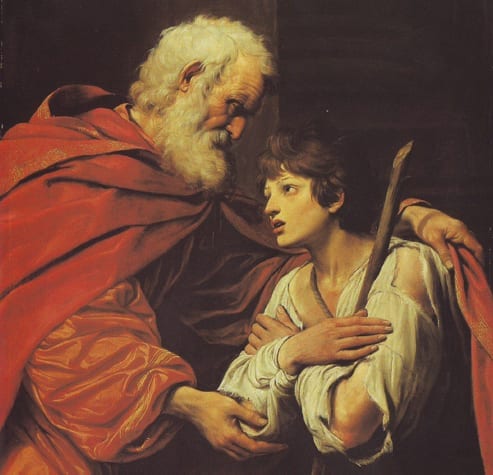
Dr. Marcellino D'Ambrosio: The Prodigal Son and The Lamb of the Passover

The parable of the Prodigal or wasteful Son is more about the loving Father.  God is not a raging tyrant who must be appeased through the suffering of his Son.  Rather it’s the extravagant love of Jesus, son of the extravagant Father, that makes atonement for our sins – the sacrifice of a spotless Passover Lamb.
For our sakes, God made him who did not know sin to be sin, so that in him we might become the very holiness of God” (2 Corinthians 5:21).
Some Christians reading these words over the last few centuries have gotten the wrong idea.  They’ve put this Scripture together with Jesus’ cry from the cross “My God, My God, why have you forsaken me.”  Plus they’ve added to the mix the Apostle’s Creed assertion that Jesus “descended into hell.”  The result is a huge misunderstanding.

THE ATONEMENT MISUNDERSTOOD

It goes something like this.  The sin of the human race called down the punishment not only of physical death and suffering but also spiritual death, total separation from God which is what hell is all about.  Jesus bore this punishment in our place.  This means that he took our sins upon himself to the point that he actually became sinful and abhorrent to the Father.  He was thus truly abandoned by God on the cross and spent three days in hell, with the rest of the damned.

SIN OFFERING & REPARATION

Let’s unravel this wrongheaded idea.  Elsewhere I’ve discussed the true significance of “My God, My God, why have you forsaken me.”   In this post, we need to clear up the other two misunderstandings.  First, there is 2 Cor 5:21.  In Hebrew, the same word means both “sin” and “sin offering,” What Paul is really saying is not that Jesus became sinful, but that he became a sin offering.
This kind of sacrifice was understood as compensation or restitution to God to make up for offending him through sin.  Honor and glory that God deserved had been withheld from Him; in the sin offering, perfect, costly animals, the most valuable possessions of the typical Israelite, were paid back to God in reparation and atonement.

PASSOVER LAMB OF GOD

The Passover Lamb had to be perfect, without blemish, and his bones could not be broken (that’s why Jesus legs were not broken on the cross like the legs of the two thieves, John 19: 32-37).  Jesus did not become sinful; he was the Lamb of God who took away the sins of the world by canceling them out through a sacrifice of overwhelming value.  His self-offering was an extravagant gift.  It consisted of all the love, humility, and obedience that centuries of human beings owed to God but had unjustly withheld from him.

PRODIGAL SON, LOVING FATHER

The Father is not a blood-thirsty tyrant whose wrath is appeased by the suffering of Jesus.  He is the loving Father in the story of the Prodigal Son who respects his son’s freedom too much to force him to stay, or to send a posse after him once his sins led him to the brink of despair.
Prodigal son passover lamb scape goat atonement jesus father
The Prodigal Son walked away in arrogance.  He would himself have to travel the road back in humility.
Adam, Eve and all of us walked away in pride.  We, their sons and daughters, would have to walk back in humility.  Trouble was, we couldn’t, so deeply had we been wounded by sin.  So God became man and walked the road for us, though it turned out to be the way of the cross.
Perfect humility.  Perfect love.  Perfect suffering.  Relentless and undeterred by every conceivable stumbling block and snare that hell could put in its way.  That is what redeemed us and paid the debt of our sins.

HE DESCENDED INTO HELL

But what about the phrase in the Apostle’s Creed “he descended into hell?”  The word used for hell means not the inferno of the damned (Gehenna), but the abode of the dead known as Sheol, Hades, or Limbo.  The meaning of this is simple– he really experienced the separation of his soul from his body.  It was no drill.  He really died.  For us.  For me.  It was love to the bitter end.
So Jesus is the conquering hero, not a passive scapegoat.  His free gift of unconquerable love is what makes atonement for our sins.  And the Father rushes out to meet him in love, clothing him (and us) with the resurrection.
The passion, then, is all about love.  For God so loved the world that he sent his only Son who would lay down his life for not only his friends, but even for his enemies.
This article on the atonement, the prodigal son, the loving Father, and the Passover lamb is a reflection on the readings for the 4th Sunday of Lent, cycle C (Joshua 5:9-12; 2 Corinthians 5:17-21; Luke 15: 11-32)

Monday, March 25, 2019

On the Solemnity of the Annunciation: A Courageous Young Girl Says No to Gay Pride in Schools of Canada

Last month, we launched a new petition to push back against a trend wherein a growing number of school boards across Canada are ordering every school in their district to fly th
e homosexual "pride" flag for the month of June.
That includes elementary schools in some districts.
Campaign Life Coalition was subsequently contacted by the mother of a Christian student who described how her daughter was negatively affected by her school’s homosexual flag activism last summer.
Her daughter, who we'll call Jessica, was in Grade 8 at the time at a public elementary school in the Greater Toronto Area that was required by the school board to fly the gay flag for the entire month of June.
Jessica felt frightened and stressed at being forced to participate in a mandatory gay pride flag-raising ceremony which contradicted her Christian beliefs.
Over 1,000 students and teachers were forced to participate.
The mother sent Campaign Life Coalition a testimony written by Jessica, describing how the homosexual flag raising ceremony was conducted as an indoctrination session, and how it traumatized her.
From Jessica, the Grade 8 student:
“I was surprised when I heard there was going to be a school-wide ceremony for the raising of the (gay) pride flag. I thought for sure that they’d at least be a bit flexible with attendance for those who didn’t want to go because of religious concerns or other concerns. I was wrong.”
“I asked the teacher who was supervising my class at the time if we HAD to go and she said it was ‘mandatory.’ She didn’t even allow me to explain my reasoning about why I didn’t want to go.”
“We were brought down to the assembly at the front of the school as a class. I was feeling uneasy as I wasn’t sure what the assembly would involve or what I might be asked to do."
"I also didn’t like that being there made me feel like I was supporting something that violates my faith.”
“There were a couple of speakers before the raising of the flag. When the time came for the (gay) pride flag to be raised, we were told to stand for this.”
“I panicked a little bit. I knew that standing meant that I was supporting this, or at least, hiding from what I really believe.”
“But sitting meant that I would be singled out. I was afraid that people would think I was a homophobe."
"Although I don’t celebrate homosexuality, I wouldn’t by any means treat someone who is a homosexual differently. People can live their lives however they want."
"But I couldn’t explain this to everyone at my school, so there were bound to be people who would think negatively about me for not standing.”
“As well as this, one of my close friends was the main speaker at this part of the assembly and a main member of the LGBTQ+ club at our school. I was afraid that her opinion of me would be changed and that she may feel personally insulted that I wouldn’t stand during her part of the assembly.”
“I decided that it wasn’t worth violating my faith for people’s opinions of me. I didn’t stand. But everyone else did. Some of my friends were like, ‘What are you doing?’ It was hard.”
“At the end of the assembly, the school played a song that had openly disrespectful lyrics insulting the Bible and Christianity. It was scary.”
“I hope I am never in another situation like that again. But I am doubtful.”
Just imagine this student's courage.
Would you have been able to stand by your convictions and remain seated like Jessica did, if you were in her shoes?
At just 14 years of age, Jessica has inspired me. I commend her and her parents for Jessica's willingness to suffer ridicule, bullying and persecution for her faith.
But, can you believe that this young girl was made to be a spectacle by her school in the first place?
By the way, the anti-Christian, Bible-hating song that the school played was Same Love by Mackelmore, which is a controversial ode to homosexual "marriage".
Read the lyrics here to learn what the school thought was appropriate to force every child and teacher in the school to listen to.
How can anyone deny that this was ideological indoctrination by the state, behind parents’ backs?
We have to stop this brainwashing in its tracks.
Our petition which has now reached almost 6,000 signatures, calls for public school trustees to ban flying the gay pride flag, and to institute a policy wherein only the Canadian flag can be flown on school property.
As parents brace for the coming homosexual flag battles that will happen across Canada in June, let’s start pushing back now, while we still have time to affect policy, by asking Trustees to respect the diversity of beliefs in their community.
Let’s ensure no more students are placed in frightening and humiliating situations like Jessica had to suffer.

Today's Quote

"Behold I make all things new." (Revelation 21:5)


Websites

See Links to Websites Below