Thursday, August 19, 2010
A Mosque Near Ground Zero!
Many questions are raised these days about the plans of building an Islamic cultural centre including a mosque near "Ground Zero." Ground Zero is the name of the New York place where the radical Islamist terrorist attacks exploded the Trade Centres towers on September 11, 2001. Almost 80% of Americans polled are opposed to the building of the Islamic cultural centre on grounds that it is a reminder of a dark day in America's history when thousands were killed by a foreign violent mob. On the other hand, Imam Faisal Abdul Raouf, who is behind the Cordoba Initiative, argues together with liberal supporters that the mosque will be a symbol for tolerance of all religions by America.
But let's look at the question from a deeper perspective. Most Muslims do not endorse violence. They follow the dictates of Islam, pray, fast at least during the month of Ramadan and seek the All-merciful God. The vast majority of Muslims oppose abortion. Pope John Paul II collaborated with Muslim countries to defeat the abortion agenda proposed at the U.N. Conference on Population and Development in Cairo, 1994. Bringing the above memory to the present, we could see in the current agenda of global Western thought a scapegoat represented by religion. Any religion is to be excluded from Western social norms and legal systems. Look at America, Canada and Europe. You will see Rene Girard's prophetic words of the scapegoat - Excluding religious prayer and teaching from public schools, religious symbols from public hospitals, religious opinion from the media. Moreover, religious institutions (particularly the still powerful Catholic Church) are shunned and attacked everywhere there is an opportunity. The recent fiasco about a few sex-offending priests is a sign. These are only signs of the scapegoat. Only the powerful remains and we are again in Darwinian lands.
As I wrote in The Economist today I wish people understand that in this age of science we cannot separate religion from life. We will never be able to remove from the human mind the need to worship. The idea of God will be with us because it responds to our quest for eternal life. Since we are the only creatures with memory, we think and relate to past events. Violence is a big problem today. The problem with building this mosque is about security. No one, it appears to me, wants to be a target of a violent destruction initiated by fellow humans "in the name of God." In spite of the formidable progress made by science, economic and political cooperation, there is an indespensable element lacking in relationships: trust. Trust requires good will which remains a hidden mystery to-date. Even if all Muslim and non-Muslim nations declare their opposition to violence, there could still be elements or people who would take advantage of religion to proclaim their victory over the others using a distorted picture of God.
From a practical view, it is better not to build the mosque in the near future as it could today explode sensitivities still fresh from 9/11 when thousands of Americans, including Muslims, were killed. The Islamic cultural centre at Ground Zero may give the impression to fundamentalist Muslims that they have won the war against America. The name itself "Cordoba" is a reminder of Islamic conquering of Spain in the Middle Ages. Christian people may interpret it as a return to Islamic invasion by other means. Then there is the fearful question: Who will fund this project. It could be the government or an organization in Iran, Lybia, Saudi Arabia or Pakistan. Some of these sources fund terrorist groups. Some commentators argued that Muslims already worship near the Pentagon. However the chapel they use is also used by other people from different religions at different times.My opinion: DO NOT BUILD the Islamic Cultural Centre nor the mosque near Ground Zero. First there must be a more profound encounter of mind and spirit between peoples. Slowly a civilization of love may emerge or may not. We must pray for it to emerge. In the end, we have hope that Christ will transform many hearts and minds for he came to save people, not to condemn them.

Saturday, July 17, 2010
A Man for All Seasons
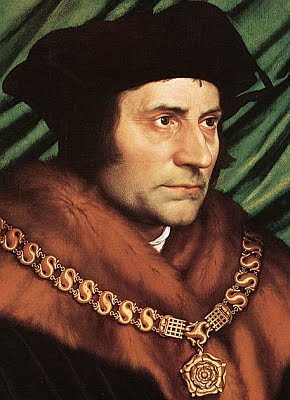
A Man for All Seasons is the name of a movie that inspired many about the heroic acts of St. Thomas More. Sir Thomas More, chancellor of 16th-century England, was a humanist and intellectual married man whose commitment to the faith never affected his devotion to his family, king, and country. On the contrary his well-formed conscience allowed him to face up to the powers of his time.
In his conversation with Cardinal Woolsey, More showed the primacy of his conscience over and against the "pressures" that Woolsey, a cleric of the Church, wanted to exert on the pope in order to obtain a divorce for King Henry VIII. The king wanted a heir to the throne since his wife Queen Catherine was barren. Thomas More's response was prayer for the king. Again his defiance of civil authorities when they trample upon the dignity of human people is supremely evident in his trial instigated by Secretary Cromwell and the betrayal of More by his friend Richard Rich who lied under oath. Thomas More was executed for "treason" along with thousands who refused to bend to the king's new unlawful laws as Supreme Head of the Church in England and his unlawful second marriage.
Today, the Church (i.e., the People of God) need another Thomas More to stand for human dignity in face of the new tyrants: Capitalist corporations whose main purpose is to gain excessive profits at the expense of poor classes and poor countries, competing for the resources of the earth. Under globalization, the entire economic world is shifting to the powerful desire for swallowing the weaker economies. On the other hand, poor countries are governed by dictators who would swallow their own people.
More to the point, we see selfishness arising from insecurity in the hearts in every land (particularly after the global recession), shyless pornography over the Internet, media catering to the powerful, division among Christians, stubborn fundamentalism in many areas of the world especially in Islamic countries, and a huge carelessness for pro-life issues. The U.N. with a liberal Western mentality is pressing women all over the world to use contraceptives and otherwise perform abortion.
In spite of the above bleak information, we believe that Christ who works in the hearts has conquered the world. In time, the world will realize the truth that Thomas More defended.
What can we do?
1. Pray more in church, at home, at work, and on the way to work. Give room to God in your heart.
2. Read and learn the teachings of Christ. You will find them in the Bible and the Church Tradition as interpreted by the Church. Recall that the Church grows in its understanding of the words and realities of the deposit of faith (Vatican II, Dei Verbum, 8). Form your conscience based on your search for the truth. A good conscience takes time to be formed. When you learn the truth from the Church, pass it on to your family and invite your friends to share it too.
3. Imitate the good shepherds and servants who work for Christ. Help the Church by offering services through her to the poor, the sick, and the alienated.
4. The hardest thing is to love the true love. Love is more than feelings. Love is an act of the will. It is shown in the experience of God's love who loved us first. We cannot love if we are not loved. God loves you. Return that love in love to everyone you encounter: Your family, your friends, your people, your co-workers, your managers, and the world. Love does not mean that you must agree with what people do but that you will their eternal salvation. Start with the little love that you offer when you sacrifice some time for another person. Offer your love in little things you do in an extraordinary way (the little way of St. Therese of Lisieux). The love of Christ did not stop there for he did not only love everyone, but also forgave them on the cross. He, the innocent lamb, did not will to retaliate nor revenge. Christ loved his enemies: the Samaritans he taught and healed, the Canaanite whose son he healed, and the Jewish authorities who condemned him to death.
Love is eternal - God is Love.
Sunday, July 4, 2010
Robert Hanna on Martyrs

This past Friday Robert Hanna, who is finishing his theological studies in Lebanon to become a priest, gave a beautiful lecture on martyrs. He chose 4 examples from the New Testament. First is St. John the Baptist, known as the forerunner in Tradition. John was the cousin of Christ. He was begotten in a miraculous way and was sanctified by the Holy Spirit when still in the womb of his mother Elizabeth (Luke 1). John's father, Zekariah the priest, prophesied that John "will be called Prophet of the Most High." John grew and lived an ascetic life in the wilderness. Before preparing the people for God, John was prepared. The most impressive fact about John is his witness to the truth regardless of the cost. He was, the Bible says, "a voice crying out in the desert" for people to repent. He baptized those who came to him for repentance. Of Christ he said "I am not worthy to loosen the thongs of his sandals. He will baptize you with the Holy Spirit and fire" (Luke 3: 16). John paid the ultimate price at a young age for admonishing King Herod of his sinful life with Herodia, his brother's wife.
The second example is St. Stephen, one of the disciples in the early Church who preached about Christ and performed wonders. Stephen was stoned to death by the Jewish elders who opposed his teaching on Christ, Son of God. What made Stephen a great example for all ages is not only his martyrdom but also his prayer to the Lord while dying "Lord, do not hold this sin against them." (Acts 7)
The third and fourth examples are Sts. Peter and Paul whose feast we celebrated on June 29. Peter was given the keys by Christ to rule over the Church, yet he did not consider himself worthy to die like Christ. He was crucified by the Roman Emperor Nero upside-down. Peter spoke the truth to all. The head of the apostles who denied Christ before the crucifixion became a transformed man after the Resurrection of Christ and spoke without fear to the people at Pentecost. He performed miracles in the name of Christ by the power of the Holy Spirit.
Paul too laboured for the Church more than anyone else, yet he considered himself the least of the apostles.
In the 16th century, one of the great martyrs is St. Thomas More. Sir Thomas More sacrificed his property, land and the good life with his beloved family, for he loved his Lord more and could not swear obedience against his conscience although King Henry VIII favoured him as Lord Chancellor of England. Thomas More was beheaded on account of "treason" but he himself said before his death "I die the subject of the king but the subject of God first."
Today, we think of those martyrs and many more that paid the ultimate price for the truth. We imitate them as they show us Christ who said "I am the Truth." The entire Christian witness is to follow in the footsteps of Christ. It takes more than talk as it requires daily sacrifice and a life of prayer. We do not have to be martyrs but we need our hearts to get less full of ourselves, our material concerns, and our comfort so that God can have more room in our hearts.
Thursday, June 24, 2010
Athanasius the Great

When he was severely persecuted by the emperor and exiled 5 times from his See of Alexandria, Athanasius the Great was once told: O Athanasius, the entire world is against you. To which, he replied: And I am against the world!
One thing that moves me about Athanasius is his perseverence for the truth even if it meant persecution and martyrdom. The hero of Christian faith in the first Ecumenical Council at Nicea (325 AD), he succeeded his Patriarch on the Apostolic See of Alexandria. He immediately worked hard to regain people lost to the Arian heresy. From 319 AD Arius, a priest in Alexandria, had preached a distorted view of the relationship of Christ to God the Father. Arius claimed that the Son (Christ) was not God but only a creature, the first of all creatures. At the Council, the young Athanasius argued that the Son was God from God. Inspired by his defence, the Council produced the Nicene Creed which was further developed at the second Ecumenical Council at Constantinople (381 AD). The amazing thing is the insistence of Athanasius to use a Greek expression for the divinity of the Son emanating from the divinity of the Father although this expression "homoosious" was not Biblical. This movement under the inspiration of the Holy Spirit is a sign of the development of doctrine in Catholic teaching, which was recently promulgated in the Second Vatican Council (Dei Verbum 8).
Athanasius is invoked not only as a saint, but also as a doctor of the Church (teacher for all generations).
Thursday, May 27, 2010
True Freedom
The only freedom we can ever have is the freedom of love. Whatever we do, we are enslaved on earth to the flesh...to the self...If you think that you are free because you live in a free democracy, you are mistaken.
Look around and you will see people carrying crosses and walking in the shadow of death. The most advanced technology cannot save you from spiritual death, unless you make a turn towards Love - God.
If you are a worrier throw your worries on the One who said "Come to me all you tired ones and put your loads on me" This is the way of saints. They became saints because they learned to unload their fears, worries and thoughts on Christ. The communion of saints is the community in which everyone loves and supports the others. They entrust themselves to Christ.
If you really wish to be free, unload your fears on Christ and tell him to give you the power of love. Work with the promptings of the Holy Spirit to receive his love and transmit it around you. For only in love there is freedom.
The powers of the world look only to expand their empires at whatever cost - militarily, economically and socially - in order to prosper even if it means the insecurity, and destruction of other people(s). No one has the right to force their own version of "freedom" on other nations. We watched with horror the second Gulf war in which hundreds of thousands were scattered and became refugees. It is terrible that a Christian president gave himself such rights of invasion causing divisions not only with his Western allies but also within Muslim sects in Iraq. Moreover, this act of unjustified aggression caused and still causes persecution of Christians living in Iraq and the Middle East in general.
This story is only one of thousands that took place on this earth causing death to millions of people. Some of the wars were justified on religious basis.
The story of the Tower of Babel reminds us that humans who want to reach to heaven on their own will fail and be divided. The name of the Devil reminds us of division. But the power of the Spirit of God unites us all humans. For God loves us. Work with the promptings of the Holy Spirit to receive his love and transmit it around you. For only in love there is freedom!
Subscribe to:
Posts (Atom)